Sylvia Plath in Devon: A Year's Turning by Elizabeth Sigmund & Gail Crowther
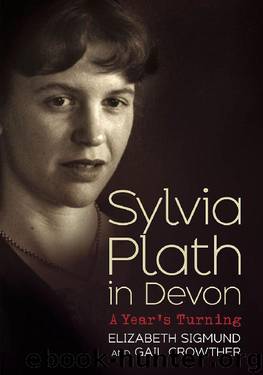
Author:Elizabeth Sigmund & Gail Crowther [Sigmund, Elizabeth]
Language: eng
Format: epub
Publisher: Fonthill Media
Published: 2014-12-07T18:30:00+00:00
She also excitedly informed her mother that they had just officially become beekeepers. The old hive had been painted white and green and now housed some docile, Italian hybrid bees. The following day was a two-starred day on the calendar indicating Plath and Hughes’s sixth wedding anniversary. If they celebrated at all it is not recorded. Tasks for the day included weeding the garden, planting seeds, painting, altering Frieda’s dress hems, and studying German.
Around 18 June, Plath wrote to Olwyn Hughes and included a picture of Nicholas. Finally, Plath claimed, she felt as though she were pulling out of three years of maternity ‘cow-push’ and was finding the time in her study a poultice. Domestic tasks, however, were relentless. In the run up to Aurelia Plath’s arrival, much cleaning and painting took place at Court Green. Following 21 June, it becomes more difficult to piece together Plath’s movements as the regular letters home to her mother obviously cease and there are few poems. Certain details can be read in letters Plath wrote to friends, but there are gaps and silences. The day after her mother arrived, Plath wrote to the Kanes, seemingly to help them to find a cottage in the West Country. In this letter she wryly reports the dramatic arrival of her mother at North Tawton Station. As Plath and Hughes were walking across the railway bridge, they saw the London train pulling away from the platform shortly followed by Aurelia Plath leaping from the moving train with her luggage and twisting her ankle as she landed.
Within three days of Aurelia Plath’s arrival, Plath and Hughes left for a trip to London. They learned that on 25 June, their neighbour Percy Key had died. Arriving back from the city, Plath viewed Percy’s body, lying in his coffin, in the cottage next door to Court Green. Once again, Plath’s X-ray vision took in every aspect to record in her journal: the colour of the coffin, Percy’s jaw propped shut with a book, the sheets flying clean and sweet in the sun. These details sat briefly in Plath’s imagination along with Percy’s funeral and burial in a nearby cemetery off Exeter Street in the town. Then on 28 June, and over the next two days, Plath wrote ‘Berck-Plage’. This extraordinary poem fuses the death of Percy Key with a visit the previous summer to Berck-Plage on the Normandy coast, a seaside town filled with hospitals and sanatoriums. Mutilated war victims and sick people took their exercise on the sands there. The beach was scattered with old concrete bunkers, gun turrets, and other relics from the war. What is especially fascinating about this poem is that the early drafts reveal that Plath intended to include a third theme in the poem—the birth of Nicholas. Thus there is the contrast of the elderly dying man, the birth of new life, and the recovery of damaged life on the beach sands in France. At some point, Plath decided to remove the reference to childbirth, which alters the theme of the poem somewhat, removing the imagery of hope.
Download
This site does not store any files on its server. We only index and link to content provided by other sites. Please contact the content providers to delete copyright contents if any and email us, we'll remove relevant links or contents immediately.
The Universe of Us by Lang Leav(15082)
The Sun and Her Flowers by Rupi Kaur(14529)
Adultolescence by Gabbie Hanna(8931)
Whiskey Words & a Shovel II by r.h. Sin(8024)
Love Her Wild by Atticus(7763)
Smoke & Mirrors by Michael Faudet(6198)
Wiseguy by Nicholas Pileggi(5795)
The Princess Saves Herself in This One by Amanda Lovelace(4985)
Love & Misadventure by Lang Leav(4853)
Memories by Lang Leav(4806)
Milk and Honey by Rupi Kaur(4754)
Bluets by Maggie Nelson(4565)
Too Much and Not the Mood by Durga Chew-Bose(4353)
Pillow Thoughts by Courtney Peppernell(4288)
Good morning to Goodnight by Eleni Kaur(4239)
The Poetry of Pablo Neruda by Pablo Neruda(4113)
Algedonic by r.h. Sin(4066)
HER II by Pierre Alex Jeanty(3614)
Stuff I've Been Feeling Lately by Alicia Cook(3460)
